Tired of identity management headaches?
Use your identity data to drive smart decisions
With Soffid’s Identity Analytics module, you’ll have access to ready-to-use strategic and tactical dashboards that will help you detect risks and unauthorised access in real time.
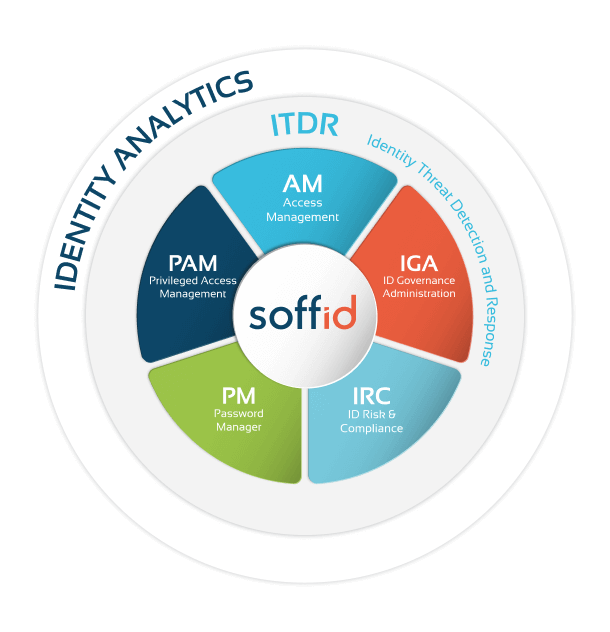
Unlock strategic information from your identity system
Identity Analytics transforms operational data from the IAM system into actionable BI dashboards. Ideal for auditing, ensuring compliance, and making evidence-based decisions.
KPIs – Risks – Audits – Access.
How can Identity Analytics help you?
Complete identity risk visibility for security teams and CISOs.
Turn your raw data into actionable information
Easily comply with applicable regulations
Real-time access measurement and control
The module allows you to classify and visualize access by employees, third parties, privileged accounts, bots, or automated systems. Ideal for detecting anomalies or unusual behavior.

Soffid has the perfect solution with a layer of visual intelligence and real-time analytics.

With Soffid, you have the flexibility to implement our solutions on your own servers (On Premise) or with a cloud-based solution (On Cloud), depending on your infrastructure needs and security preferences.
From banking and healthcare to education and government, this solution adapts to each industry’s size, regulations, and complexity.
Discover how companies from a wide range of industries have successfully transformed their security and identity management with Soffid solutions. Check out the success stories that illustrate how we can help you achieve your goals.







Network with our experts and discover how you can leverage the data in your IAM system to achieve visibility, control, and efficiency.
Access articles that are relevant to your industry and find out how our solutions can transform your digital infrastructure.
Soffid participated in the @aslan Association’s “Cybersecurity & AI” Trends 2026 Forum, where Gabriel Buades, Founder and CTO of Soffid, discussed the role of identity management as the foundation of IT security in a context shaped by AI, cyberresilience, and the disappearance of the traditional perimeter.
At Soffid, we took part in the ASLAN 2026 Congress & EXPO as sponsors of the ASLAN Association Awards for Digital Transformation in Public Administration. In addition, Gabriel Buades gave a presentation on how digital identity and artificial intelligence can turn security policies into real, automated controls.
Here’s what RSAC 2026 looked like for Soffid: a few intense days in San Francisco connecting with the cybersecurity ecosystem, exchanging ideas, and reinforcing key conversations around identity security, access governance, and resilience in hybrid and cloud environments, together with the Spain Pavilion alongside ICEX + INCIBE.
Soffid participated in the @aslan Association’s “Cybersecurity & AI” Trends 2026 Forum, where Gabriel Buades, Founder and CTO of Soffid, discussed the role of identity management as the foundation of IT security in a context shaped by AI, cyberresilience, and the disappearance of the traditional perimeter.
At Soffid, we took part in the ASLAN 2026 Congress & EXPO as sponsors of the ASLAN Association Awards for Digital Transformation in Public Administration. In addition, Gabriel Buades gave a presentation on how digital identity and artificial intelligence can turn security policies into real, automated controls.
Here’s what RSAC 2026 looked like for Soffid: a few intense days in San Francisco connecting with the cybersecurity ecosystem, exchanging ideas, and reinforcing key conversations around identity security, access governance, and resilience in hybrid and cloud environments, together with the Spain Pavilion alongside ICEX + INCIBE.
Learn how Identity and Access Management strengthens security, prevents fraud, and improves user experience in e-commerce and digital business environments with Soffid IAM.
A guide on how advanced IAM solutions enable financial organizations to protect identities, prevent fraud, and maintain compliance without impacting operations.
Discover how CIE Automotive strengthened security, regulatory compliance, and operational efficiency across its industrial plants with a centralized IAM strategy powered by Soffid.
At Soffid, every conversation can lead to a tailor-made solution
A SIEM correlates log events against known signatures and rules; identity analytics builds a behavioral baseline per identity — typical login times, locations, applications accessed, data volumes touched — and flags deviations from that individual's own pattern, which a rules-based SIEM isn't designed to do. IAM logs record what happened (who logged in, when), but they don't score whether that event is abnormal for that specific person. The genuine value-add is detecting the "technically authorized but behaviorally unusual" case — a valid credential used in an atypical way — which is exactly the gap between logging access and understanding whether it's normal.
Expect a meaningfully higher false-positive rate in the first one to two months while behavioral baselines are still immature, tapering off as the system accumulates enough history per identity to distinguish real anomalies from normal variation. Plan for active analyst involvement during this window — reviewing flagged events and confirming or dismissing them measurably improves the model faster than leaving it untouched. Budgeting dedicated tuning time in the first quarter, rather than assuming the tool works out of the box at full accuracy, is what prevents the alert fatigue that gives UEBA tools a bad reputation.
Plan on roughly 60 to 90 days of baseline-building before alert quality reaches a level you'd trust for automated response actions, though basic anomaly flagging starts producing useful (if noisier) signal earlier than that. During this ramp-up window, treat alerts as informational rather than actionable, and set that expectation with stakeholders up front so the tool isn't judged as underperforming during a phase where immature baselines are expected. Identities with irregular schedules (contractors, on-call staff) typically take longer to baseline accurately than standard 9-to-5 employees.
Basic anomaly dashboards are increasingly bundled into IAM/IGA and SIEM platforms, but those built-in features are typically limited to surface-level alerts rather than a full behavioral risk model that feeds back into access and governance decisions. Soffid's identity analytics is integrated with the same platform's governance and access management data, which means risk scores can directly inform certification priority and access policy — a bundled feature in a separate platform usually can't do that because it doesn't have access to your governance data. If your need is a basic anomaly dashboard, a bundled feature may be enough; if you want risk scoring to actually change access decisions, that requires the tighter integration a standalone, platform-connected module provides.
Soffid's risk scoring is built to surface the specific contributing factors behind a score — which behaviors were flagged as unusual and why — rather than presenting a single opaque number with no explanation. When a score triggers a restriction or investigation, you can show the auditor or executive the underlying factors (new location, unusual access volume, atypical timing) in plain language rather than asking them to trust an unexplained machine output. This traceability is what makes a risk score defensible in an audit or board conversation, versus a model that can only say "risk is high" without saying why.
Continuous behavioral monitoring of employees can trigger works-council consultation requirements or employee privacy obligations in several EU countries, independent of which vendor's tool you use — this is a legal question about the practice, not just the software. Soffid's analytics can be scoped and configured around what's tracked and how findings are used (security risk scoring versus, say, performance monitoring), which helps keep the deployment inside a defensible, security-only purpose. Before rolling this out, involve your works council or employee representatives and legal/privacy counsel on scope and purpose — that consultation needs to happen regardless of which identity analytics product you choose.