Tired of identity management headaches?
ID Risk & Compliance (IRC)
Soffid IRC adapts risk management to the most demanding standards (ISO27001, PCI DSS, GDPR, NIS, DORA, HIPAA, among others), and ensures continuous compliance by means of identity re-certifications and periodic permission validation.
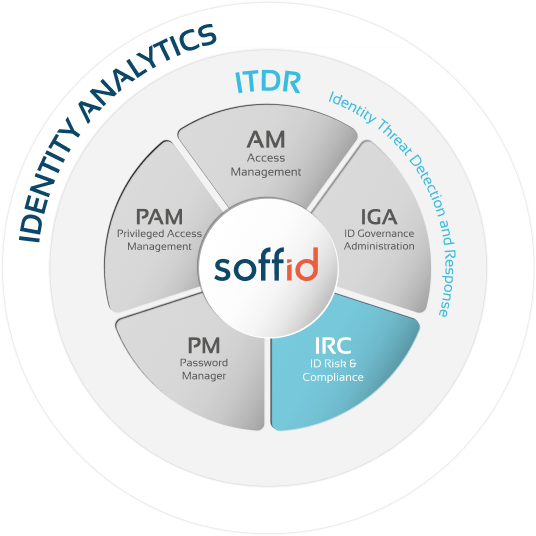
Soffid IRC (ID Risk & Compliance) offers a comprehensive identity risk management solution to ensure compliance with legal and security regulations.
With automated audits and real-time controls, Soffid IRC detects, prevents and reduces unauthorised access, ensuring that only authorised users can access the organisation’s critical resources.
Continuous auditing:
Automatically audits access and resource usage, ensuring regulatory compliance.
Risk mitigation:
Identify and mitigate identity risks by means of automated controls and reviews.
Regulatory compliance:
Ensures compliance with regulations such as GDPR, SOX, HIPAA, and more.
Centralised visibility:
Get detailed real-time reports regarding access, permissions and changes.
Soffid IRC provides advanced features to manage identity risk and ensure:
Our system monitors access to your network resources and detects any suspicious activity.
You will receive automatic alerts about possible breaches or unauthorised access.
Avoid conflicts of interest by ensuring that users don’t have incompatible permissions (such as permission to create and approve the same transaction or operation).
Ensures users receive only the necessary access required to carry out their tasks.
A security approach that, by default, doesn’t trust any user or system, even if they are already within the corporate network or environment.
Soffid IRC manages all types of identities in your organisation
Employees, administrators, and collaborators.
Suppliers, customers, and contractors.
Applications, APIs, and other services.

Soffid ID Risk & Compliance addresses several common issues faced by organisations:
The segregation of duties and the principle of least privilege ensure productivity while minimising risk.
Soffid IRC allows you to define which regulatory framework should be applied and ensures its ongoing compliance.
Detailed and customisable reporting, along with full forensic auditing.

With Soffid, you have the flexibility to implement our solutions on your own servers (On Premise) or with a cloud-based solution (On Cloud), depending on your infrastructure needs and security preferences.
Soffid IRC adapts to a variety of industries, providing customised solutions to manage identity risk and compliance:
Businesses from a wide range of industries have revolutionized their security and identity management using Soffid solutions.







Request a free demo or a free trial and discover how Soffid IRC discover how Soffid IRC can help you manage identity risk and ensure legal compliance in your organisation.
Access articles that are relevant to your industry and find out how our solutions can transform your digital infrastructure.
Soffid participated in the @aslan Association’s “Cybersecurity & AI” Trends 2026 Forum, where Gabriel Buades, Founder and CTO of Soffid, discussed the role of identity management as the foundation of IT security in a context shaped by AI, cyberresilience, and the disappearance of the traditional perimeter.
At Soffid, we took part in the ASLAN 2026 Congress & EXPO as sponsors of the ASLAN Association Awards for Digital Transformation in Public Administration. In addition, Gabriel Buades gave a presentation on how digital identity and artificial intelligence can turn security policies into real, automated controls.
Here’s what RSAC 2026 looked like for Soffid: a few intense days in San Francisco connecting with the cybersecurity ecosystem, exchanging ideas, and reinforcing key conversations around identity security, access governance, and resilience in hybrid and cloud environments, together with the Spain Pavilion alongside ICEX + INCIBE.
Learn how Identity and Access Management strengthens security, prevents fraud, and improves user experience in e-commerce and digital business environments with Soffid IAM.
A guide on how advanced IAM solutions enable financial organizations to protect identities, prevent fraud, and maintain compliance without impacting operations.
Discover how CIE Automotive strengthened security, regulatory compliance, and operational efficiency across its industrial plants with a centralized IAM strategy powered by Soffid.
Soffid participated in the @aslan Association’s “Cybersecurity & AI” Trends 2026 Forum, where Gabriel Buades, Founder and CTO of Soffid, discussed the role of identity management as the foundation of IT security in a context shaped by AI, cyberresilience, and the disappearance of the traditional perimeter.
At Soffid, we took part in the ASLAN 2026 Congress & EXPO as sponsors of the ASLAN Association Awards for Digital Transformation in Public Administration. In addition, Gabriel Buades gave a presentation on how digital identity and artificial intelligence can turn security policies into real, automated controls.
Here’s what RSAC 2026 looked like for Soffid: a few intense days in San Francisco connecting with the cybersecurity ecosystem, exchanging ideas, and reinforcing key conversations around identity security, access governance, and resilience in hybrid and cloud environments, together with the Spain Pavilion alongside ICEX + INCIBE.
Learn how Identity and Access Management strengthens security, prevents fraud, and improves user experience in e-commerce and digital business environments with Soffid IAM.
A guide on how advanced IAM solutions enable financial organizations to protect identities, prevent fraud, and maintain compliance without impacting operations.
Discover how CIE Automotive strengthened security, regulatory compliance, and operational efficiency across its industrial plants with a centralized IAM strategy powered by Soffid.
At Soffid, every conversation can lead to a tailor-made solution
Applicability depends on your sector and size — DORA applies to financial entities and their critical ICT providers operating in the EU, while NIS2 covers a broader set of "essential" and "important" entities across many sectors; if you're unsure whether you're in scope, that determination itself is worth confirming with legal/compliance counsel rather than guessing from vendor content. Partial compliance by the deadline still carries real regulatory and financial exposure under both frameworks — the honest guidance is to prioritize the areas where you have the least visibility today (typically third-party/supply-chain access and identity risk inventory) since those are commonly the biggest gaps. Soffid's IRC module is built to map directly to control requirements under both frameworks so you can show concrete evidence of controls in place, not just a stated intent to comply.
The three frameworks overlap heavily on identity-related controls — access governance, audit trails, third-party risk visibility, breach notification readiness — so a single identity risk and compliance model can genuinely cover the shared ground across all three rather than needing separate identity tooling per regulation. What still needs framework-specific configuration is the reporting layer: DORA and NIS2 incident reporting formats and GDPR data-subject request handling have distinct procedural requirements that sit on top of the same underlying identity risk data. Expect to configure framework-specific reports and workflows, not rebuild your risk model for each one.
Soffid's IRC module continuously discovers and maps identities, entitlements, and third-party access across connected systems rather than relying on a periodic manual inventory exercise — which is what typically leaves organizations scrambling right before an audit. The inventory stays current because it's built from live connector data (who has access to what, right now), not from a spreadsheet someone updates quarterly. Getting full coverage still depends on connecting all your relevant systems and third-party access points, so the completeness of the inventory is only as good as what's actually connected.
A general GRC tool manages risk registers, policy documents, and audit workflows across the whole organization — finance, operations, physical security, and more — typically fed by manual attestations and periodic reviews. Soffid's IRC module is identity-specific and pulls live data on actual entitlements, access patterns, and third-party identity risk directly from your systems, which a general GRC tool doesn't natively collect. Most organizations with a broader GRC program keep it for organization-wide risk governance and feed it identity risk data from a dedicated platform like Soffid, rather than choosing one or the other.
Soffid evaluates SoD rules at the point of access request and grant — so a request that would create a conflicting combination (initiate and approve the same payment, for example) is flagged or blocked before it's granted, not discovered later in a report. Existing conflicts from access granted before the rules were in place are surfaced through ongoing SoD scans against current entitlements, so you can remediate what already exists in addition to preventing new conflicts. That combination — preventive checks at request time plus detective scans of existing access — is what turns SoD from a written policy into something the system actually enforces.
The IRC module replaces manual tracking at its source — identity risk scores, entitlement inventories, and third-party access data are pulled live from connected systems rather than manually compiled into a spreadsheet by someone on your team. The distinction that matters is whether the underlying data collection changes, not just whether there's a nicer dashboard: if you still have to manually populate the inputs, you haven't actually changed the process, you've just visualized it. Here, the connectors do the data collection, and the dashboard reflects live state, not a periodically-updated manual snapshot.
Soffid's IRC module extends identity risk visibility to third-party and vendor identities with access to your systems — tracking what access external parties actually hold, when it was granted, and whether it's still needed — which is the specific gap both DORA and NIS2 require you to close for ICT and supply-chain oversight. This covers the identity/access dimension of third-party risk specifically; broader vendor risk assessment (financial stability, contractual terms, security posture questionnaires) still needs to be tracked through your vendor management process, with IRC feeding it the access-risk piece.