Tired of identity management headaches?
Protect your identities with real-time, automated actions
Soffid Identity Threat Detection and Response (ITDR) detects threats, responds automatically, and assigns remediation tasks to your team in seconds.
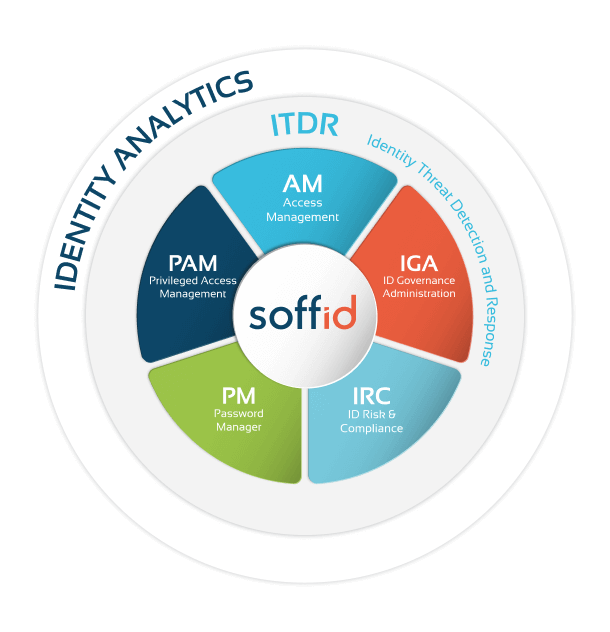
A smart defense layer for your identities
Soffid Identity Threat Detection and Response (ITDR) identifies and mitigates threats across hybrid and cloud environments. It adds visibility, automated analysis, and rapid response capabilities to your access management system.
Who benefits from identity threat detection and response (ITDR)?
Security teams and CISOs needing fast and automated threat response.
CIOs seeking enhanced identity protection across complex infrastructures.
Organizations operating in multi-cloud environments requiring continuous visibility.
Compliance officers who need to manage incidents and evidence quickly and efficiently.
ITDR continuously analyzes the behavior of employees, privileged accounts, third parties, bots, and automated systems—detecting abnormal access and unusual activity patterns.

With Soffid, you have the flexibility to deploy our solutions on your own servers (On-Premise) or in the cloud (On-Cloud), depending on your infrastructure and security requirements.
Soffid ITDR is built to meet the specific needs of different sectors, providing secure and efficient access management:
See how organizations across industries have transformed their identity security and access governance with Soffid. Explore our success stories and learn how we can help you achieve your goals.







Connect with our experts and discover how Soffid ITDR can revolutionize your identity management strategy with visibility, automation, and advanced security.
Access more insights and learn how our solutions can strengthen your digital infrastructure.
Soffid participated in the @aslan Association’s “Cybersecurity & AI” Trends 2026 Forum, where Gabriel Buades, Founder and CTO of Soffid, discussed the role of identity management as the foundation of IT security in a context shaped by AI, cyberresilience, and the disappearance of the traditional perimeter.
At Soffid, we took part in the ASLAN 2026 Congress & EXPO as sponsors of the ASLAN Association Awards for Digital Transformation in Public Administration. In addition, Gabriel Buades gave a presentation on how digital identity and artificial intelligence can turn security policies into real, automated controls.
Here’s what RSAC 2026 looked like for Soffid: a few intense days in San Francisco connecting with the cybersecurity ecosystem, exchanging ideas, and reinforcing key conversations around identity security, access governance, and resilience in hybrid and cloud environments, together with the Spain Pavilion alongside ICEX + INCIBE.
Soffid participated in the @aslan Association’s “Cybersecurity & AI” Trends 2026 Forum, where Gabriel Buades, Founder and CTO of Soffid, discussed the role of identity management as the foundation of IT security in a context shaped by AI, cyberresilience, and the disappearance of the traditional perimeter.
At Soffid, we took part in the ASLAN 2026 Congress & EXPO as sponsors of the ASLAN Association Awards for Digital Transformation in Public Administration. In addition, Gabriel Buades gave a presentation on how digital identity and artificial intelligence can turn security policies into real, automated controls.
Here’s what RSAC 2026 looked like for Soffid: a few intense days in San Francisco connecting with the cybersecurity ecosystem, exchanging ideas, and reinforcing key conversations around identity security, access governance, and resilience in hybrid and cloud environments, together with the Spain Pavilion alongside ICEX + INCIBE.
Learn how Identity and Access Management strengthens security, prevents fraud, and improves user experience in e-commerce and digital business environments with Soffid IAM.
A guide on how advanced IAM solutions enable financial organizations to protect identities, prevent fraud, and maintain compliance without impacting operations.
Discover how CIE Automotive strengthened security, regulatory compliance, and operational efficiency across its industrial plants with a centralized IAM strategy powered by Soffid.
At Soffid, every conversation is the beginning of a tailor-made solution.
SIEM correlates security events across your whole environment and EDR watches endpoint behavior; neither is purpose-built to model identity-specific attack patterns like entitlement escalation, unusual group membership changes, or credential misuse chained across systems that don't touch a single endpoint. ITDR specifically focuses on the identity plane — detecting when an account, credential, or entitlement is being abused, regardless of which endpoint or application it touches. It's a genuinely distinct detection surface, not a rebrand, but it's meant to feed your SOC and SIEM, not replace them.
IdP-native protections typically catch known bad patterns (impossible travel, brute force) but don't correlate entitlement changes, privilege escalation, and behavioral anomalies into a single identity-risk picture the way a dedicated ITDR capability does. If your SIEM already ingests rich identity telemetry and you've built custom correlation rules for account takeover patterns, you may have partial coverage — but most organizations haven't built that, which is the actual gap ITDR closes. Soffid's ITDR is built into the same platform as governance and analytics, so it reuses identity context you already have rather than requiring you to stand up and feed a fully separate system.
Detection combines several signal types — entitlement and group membership changes, deviation from an identity's behavioral baseline, and correlation across systems (a privilege escalation shortly after an unusual login, for example) — rather than relying on any single rule like failed-login count or geographic distance between logins. Simple conditional-access rules catch the obvious cases; genuine account-takeover detection is about catching the combination of a valid credential plus abnormal downstream behavior, which is exactly what a single login/location rule misses.
Soffid's ITDR alerts are designed to feed into your existing SIEM and ticketing workflow rather than creating a standalone console — findings are enriched with identity context (which entitlements, which risk score, which behavioral trigger) before they reach the analyst, so they arrive as actionable tickets, not raw data requiring another tool to interpret. Whether it becomes "yet another queue" in practice depends on how you configure the integration at rollout; the platform supports feeding a single SOC workflow, but that has to be the explicit configuration choice you make during deployment.
Soffid supports configurable automated response actions — forcing re-authentication, suspending an account, or revoking a specific session — triggered by defined risk thresholds, not just notification-only alerting. How aggressive that automation is should be a deliberate choice: full automatic account suspension on a high-confidence signal reduces attacker dwell time but carries a real risk of disrupting a legitimate user if the model is wrong, so most organizations start with automated alerting plus a fast manual response path and only move to fully automatic containment once they trust the detection accuracy for their environment.
MFA and PAM reduce the odds of a credential being stolen or a privileged account being abused in the first place, but neither one detects an attacker who's already using a valid, MFA-passed session or a legitimately checked-out privileged credential in an abnormal way — that detection gap is specifically what ITDR closes. The honest sequencing is: fix any real gaps in MFA coverage and privileged access controls first, since those are cheaper and address more of the risk, then add ITDR as the layer that catches what preventive controls miss once an attacker is already past them. Treating ITDR as a replacement for stronger MFA/PAM rather than a complement to them is the wrong frame either way.
The attack techniques differ meaningfully — Kerberoasting and golden ticket attacks are AD-specific, while token theft and OAuth consent abuse are cloud/SaaS-specific — so a genuinely capable ITDR platform needs distinct detection logic for each environment, not a single generic rule set applied everywhere. Soffid's ITDR is built to monitor both hybrid AD and cloud identity threats within one platform, so you're not stitching together separate on-prem and cloud-only tools, but you should confirm which specific AD and cloud attack techniques are covered for your environment rather than assuming "hybrid support" means every technique is covered equally well.